Short answer
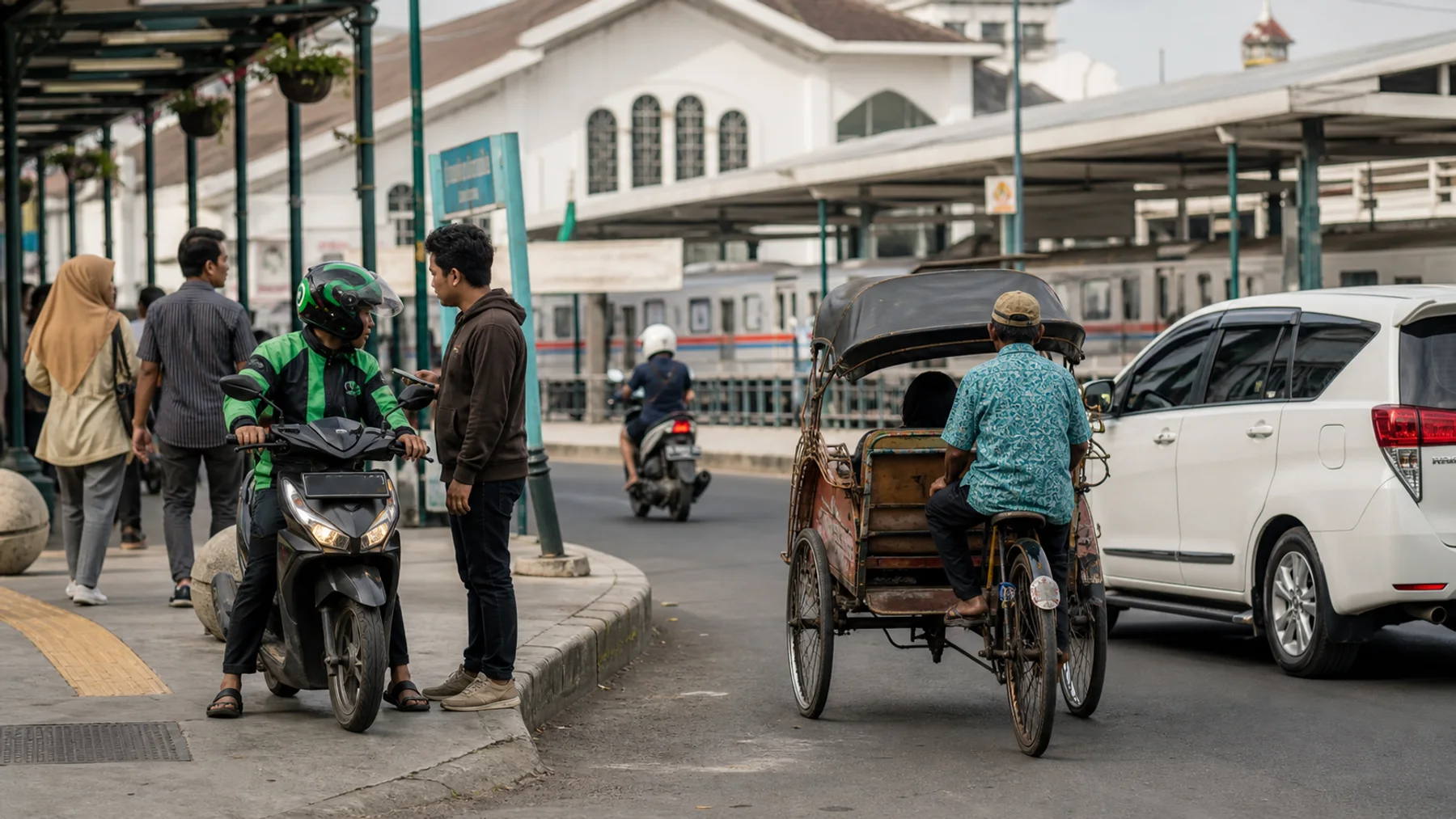
For most visitors, Yogyakarta transport is simple: use Grab or Gojek for short city rides, a private driver or tour for longer day trips, and public transport only when the route is genuinely clean.
The mistake is trying to use one transport mode for everything. Jogja is not a puzzle you win by refusing taxis.
Choose transport by the day shape
Jogja is easy when the day has one transport logic. It gets annoying when you mix temple timing, food stops, rain and long crossings without a plan.
| Day shape | Best first choice |
|---|---|
| Malioboro, Kraton, Taman Sari and central food | Walk plus short app rides. |
| Borobudur or Prambanan day | Driver, tour or route-specific public transport plan. |
| Airport to Malioboro/Tugu | Airport train can work well if timing and luggage fit. |
| Airport to Prawirotaman | Direct car or train plus final ride, depending on timing. |
| Merapi/Kaliurang | Driver or organized tour, not improvised app hopping. |
| Rainy day | Shorter clusters and more car backup. |
Do not choose transport by what sounds cheapest. Choose the mode that keeps the day from falling apart at the transfer point.
What to check before you go
Before building the day, recheck opening hours, ticket rules, event schedules, route changes and holiday closures. Jogja is easy until one fixed-time detail is wrong.
Best option for most travelers
Use ride-hailing for ordinary city movement. It is the practical choice for hotel to Kraton, Prawirotaman to Malioboro, dinner runs, market stops and getting back when you are hot.
If you have not chosen a base yet, use where to stay in Yogyakarta first. Transport gets easier when the hotel area is not fighting the itinerary.
Use a private driver when you leave the central city or want several stops in one day. Borobudur, Merapi, beaches, Kaliurang and craft villages can become annoying if you stack rides one by one.
Use public transport when it matches the route. Not when it merely exists.
That is the whole Yogyakarta transport philosophy. The city is not huge, but heat, traffic, station access and last-mile gaps matter. A cheap route that takes three legs and drains your afternoon is not a win. A paid ride that saves time can be good value.
Best transport by actual plan
| Plan | Best transport | Why |
|---|---|---|
| Malioboro, Kraton and Taman Sari | Walking plus short app rides | The area can work as a compact city day if heat is managed |
| Prawirotaman dinner | Grab, Gojek or taxi | Simple door-to-door ride beats a sweaty walk home |
| Kotagede | Ride app or driver if combined with shopping/craft | It is close enough to visit, but not always a clean walk/transit day |
| Prambanan | Taxi, driver, tour or verified public transport | Return timing and ticket rules matter |
| Borobudur | Driver or tour for most visitors | Distance and access rules make DIY more fragile |
| Airport to city | Train or transfer depending on hotel and luggage | Malioboro/Tugu is different from Prawirotaman |
| Shopping half-day | Ride app or driver | Combining distant areas is where transport matters |
Compare the options
| Option | Best for | Weak point | What to verify |
|---|---|---|---|
| Grab / Gojek car | City rides, dinner, bags | Traffic, pickup friction | App coverage and pickup zones |
| Gojek / Grab bike | Solo travelers, short hops | Luggage, rain, safety comfort | Helmet and pickup logic |
| Taxi | Simple door-to-door rides | Price can vary by context | Meter or fixed-rate rules |
| Private driver | Day trips, families, multi-stop plans | Costs more | Inclusions and waiting time |
| Trans Jogja | Budget routes, some landmarks | Walking and transfers | Current route map and payment |
| KAI Commuter | Solo/Prambanan direction when useful | Station access and timing | Schedules and ticketing |
| Walking | Compact neighborhoods | Heat and sidewalks | Route safety and shade |
| Scooter rental | Confident riders | Risk, police, insurance | License and rental rules |
Taxi apps and taxis
Grab and Gojek are the default tools for many travelers. Open both, compare pickup time and price, then choose. This is not a brand loyalty ceremony.
Cars are better for luggage, rain and groups. Bikes are quicker for solo travelers without bags, but only if you are comfortable riding pillion in traffic.
Taxis can still be useful, especially from hotels, stations and airports. A fixed-rate or official taxi can be convenience rather than a scam when it removes pickup confusion, luggage stress or late-night uncertainty.
At airports and stations, pickup rules can be more specific than inside normal city streets. Grab publishes airport pickup guidance for Yogyakarta International Airport, including an airport-car product and pickup instructions. Use the app and signs on the day, not a memory from a past trip.
For the airport rail version, use the Yogyakarta Airport Train Guide or the Yogyakarta Airport to Malioboro guide before guessing from the terminal.
Private drivers
A driver makes sense when your day has distance, waiting time or multiple stops. That includes Borobudur, Ratu Boko plus Prambanan, Merapi jeep areas, Parangtritis, Kaliurang or a craft/shopping day outside the center.
For the two big temple routes, compare Borobudur from Yogyakarta and best things to do in Yogyakarta before choosing train, taxi, driver or tour.
Make the cost logic honest. You are paying for a car, fuel, time, local navigation, waiting and flexibility. A scooter is cheaper because it is a different product.
For driver or tour affiliate blocks, list inclusions clearly: pickup area, vehicle size, fuel, parking, waiting time, overtime, entrance tickets, meal stops, cancellation rules and whether the driver is a guide or just transport. Those are not tiny details. They decide whether the booking is good value.
Trans Jogja
Trans Jogja can be useful for budget travelers and some city routes. The official tourism and transport sources should be used for the current route map, stops, payment and service notes.
Do not pretend buses are always easier because they are cheaper. If the route requires a long walk in heat, a transfer, and then a taxi anyway, say that plainly.
DIY Transport Agency’s Trans Jogja page lists route and stop information, a map, payment notes and operating-hour data. That is the right source for current route checks. For tourists, the question is not “does a bus exist?” The question is “does this bus get me close enough, at the right time, with a payment method I can use?”
Trains around Yogyakarta
KAI Commuter can matter for routes toward Solo and some Prambanan-side planning, but station access and schedules decide whether it is useful for a tourist day.
If a traveler is already near Tugu Station or Lempuyangan and the timetable works, rail can be smart. If they are in Prawirotaman with bags or a tight schedule, a car may be better.
Rail is especially easy to romanticize because it looks clean on a map. Add the walk to the station, waiting time, ticket process, final ride and return plan. If it still works, use it. If not, take a car and stop pretending the map solved the day.
If your rail idea is actually a Solo side trip, read Yogyakarta to Solo before treating it as a casual local hop.
Walking
Walk around Malioboro, parts of the Kraton area, Prawirotaman streets and compact market areas when the weather is friendly. Do not build a full itinerary around heroic walking in midday heat.
Short walks are travel. Long sweaty slogs are poor planning with nicer branding.
The best walking zones are compact: Malioboro to Beringharjo, parts of the Kraton area, Prawirotaman streets, and small market or neighborhood loops. Walking from one side of the city to another may be possible. Possible is not the same as pleasant.
Scooter rental
Scooters are efficient if you already ride confidently, have the right license situation, understand insurance implications, and accept the traffic risk.
If you do not ride at home, Jogja is not where you become a new person. Use apps and drivers.
Do not rent a scooter just because Jogja looks smaller than Jakarta. Heat, traffic, parking, rain, unfamiliar roads and insurance/legal issues still count. If the only reason is saving a few rides, this is not automatically smart.
Also check your travel insurance. Many policies care about license status, helmet use and whether you were legally allowed to ride. The cheap scooter is not cheap if a crash becomes an insurance argument.
Which option should you choose?
- City hop: Grab, Gojek or taxi.
- Temple day: driver, tour or train only if verified.
- Borobudur: driver or tour for most visitors.
- Prambanan: taxi, driver, tour or verified public transport.
- Merapi and beaches: driver or tour.
- Food night: ride-hailing.
- Station transfer: taxi or ride-hailing unless walking is clearly easy.
For airport transfers, split the question by hotel area. Malioboro/Tugu works well with the airport train when timing lines up. Prawirotaman usually needs a direct car or train plus final ride. Families and late arrivals should bias toward direct transport.
Common mistakes
- Planning every ride from old fare screenshots.
- Assuming public transport reaches every attraction cleanly.
- Renting a scooter without the skills or paperwork.
- Booking day trips without checking return transport.
- Forgetting that rain changes everything.
How to plan days by transport
The cleaner way to plan Jogja is to group days by movement style. Use short app rides for Malioboro, the Kraton area, Taman Sari, Prawirotaman and Kotagede. Use a driver or tour structure for Borobudur, Merapi, beaches and anything that involves waiting, parking or a return ride from outside the city core.
Do not build one day from scattered pins just because the map makes them look close. A good Jogja day has fewer transfers, fewer awkward pickup points and enough time to actually enjoy the stop you came for.
FAQ
Can you get around Yogyakarta without a scooter?
Yes. Use ride-hailing, taxis, drivers and selective public transport.
Is Grab or Gojek better in Yogyakarta?
Use both. Availability changes by area, time, rain and pickup point.
Is Trans Jogja useful for tourists?
Sometimes. It needs route and payment checks before recommending it for a specific itinerary.
Do I need a private driver?
Not inside the central city. Yes, often, for day trips with distance or multiple stops.
Sources for changing details
Routes, stops, fares, payment rules, operating hours, transfer points and service updates can change. Use these pages before relying on exact transport details.

I'm the person behind Simply Indonesia. I lived in Yogyakarta and Bali for more than five years, which is long enough to know that Indonesia is amazing, messy, generous, occasionally confusing and very bad at fitting into generic travel-blog advice.
I'm also a manual-brew coffee nerd, dangerously loyal to sate klathak, and far too interested in the small practical details that decide whether a trip feels smooth or stupidly annoying.
I write these guides for travelers who want the useful version: how to get out of the airport, where to stay, what food actually tastes like, when paying extra is normal, and when something really deserves a hard no.
No fake hidden gems. No "paradise awaits" nonsense. No panic about every 50k IDR price difference.