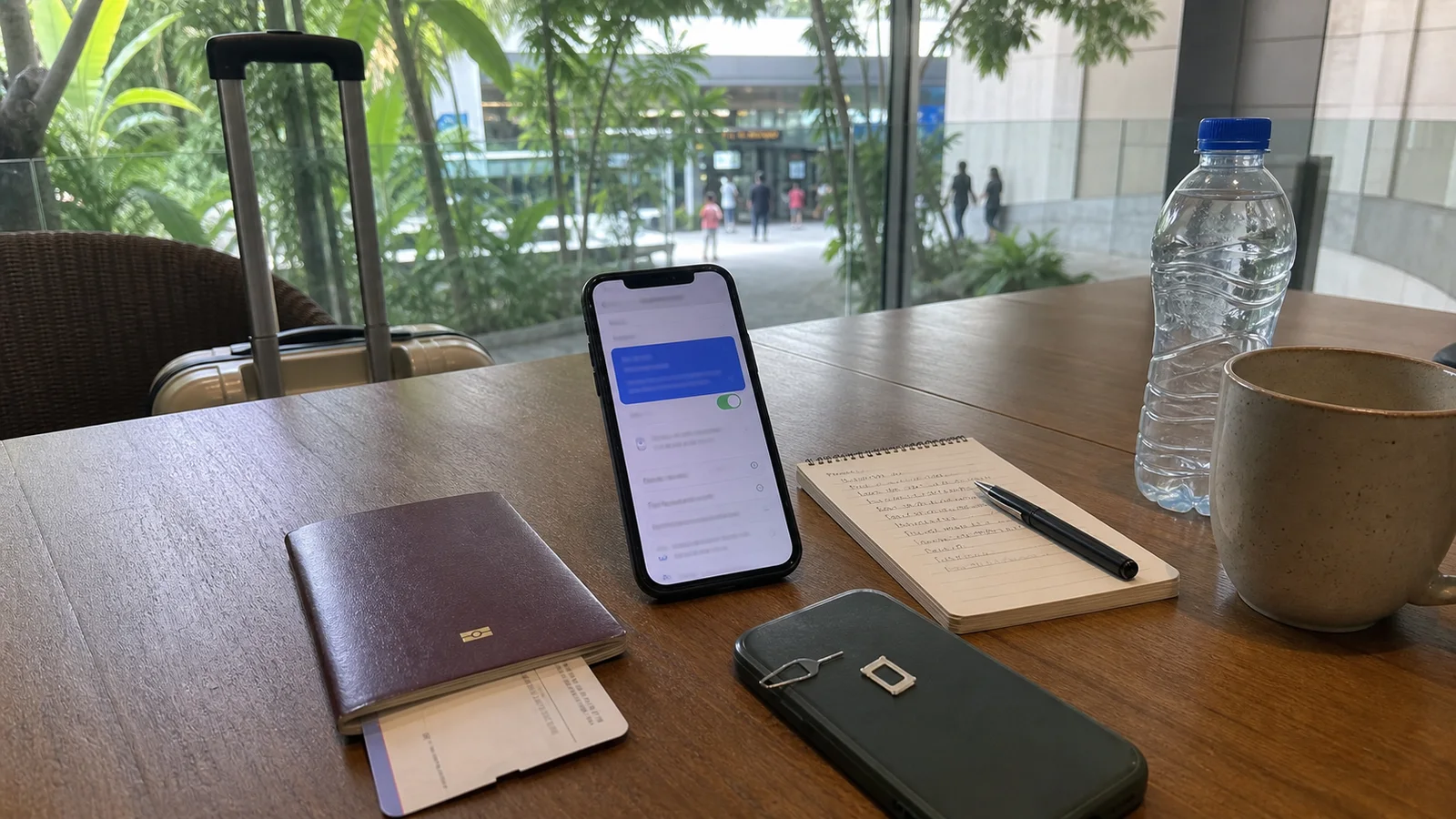
Best Bali eSIM by traveler type
The useful question is not “Which provider has the loudest checkout page?” It is “Which setup solves the trip I am actually taking?”
If you just want the boring default: choose a 5-10GB Indonesia eSIM before departure for a one-week Bali trip. Compare Telkomsel foreigner/local SIM options only if you stay longer, need a local number or use enough data to make setup worth it.
| Traveler type | Best default | Why | Check before buying |
|---|---|---|---|
| 5-10 day Bali trip | Fixed-data travel eSIM | Easy arrival, enough for maps, WhatsApp, Grab/Gojek and light browsing | Data amount, validity, activation timing |
| 10-14 day normal trip | 10GB+ fixed-data plan | More breathing room without turning data into a daily anxiety project | Top-up rules, network partner, expiry date |
| Heavy data or remote work | Large fixed-data or unlimited-style plan | Less topping up, better for uploads and backup work | Fair use, hotspot, throttling, support |
| Laptop hotspot needed | Plan with explicit tethering support | Some plans restrict data sharing or slow down after limits | Hotspot wording on the exact plan screen |
| 30 days or local number | Telkomsel foreigner/local SIM comparison | Often better local value and number options | Passport, IMEI, pickup/setup, current package |
| Bali plus Java or Lombok | Indonesia-wide plan | Avoid buying something too narrow for the route | Network partner and coverage outside Bali |
Quick provider checks
Start with the use case, then check the provider screen
Current Bali eSIM plan examples
These are live-provider examples checked in May 2026, not permanent tariffs. Prices, discounts, data tiers, network partners and fair-use wording can change before your trip. Use this table for scale, then check the final provider screen before paying.
| Provider or route | Current examples checked | What it means |
|---|---|---|
| Airalo Indonesia eSIM | From US$4.50 on the official Indonesia eSIM page; fixed-data examples include 1GB/7 days, 3GB/30 days, 10GB/30 days and 20GB/30 days | Good check for normal short trips and simple fixed-data buying |
| Nomad Indonesia eSIM | From about US$4 on the official Indonesia eSIM page; examples include 1GB/7 days, 10GB/30 days, 20GB/45 days, 50GB/45 days and unlimited-day options | Good check for bigger data bundles, hotspot needs and longer validity windows |
| Holafly Indonesia eSIM | Unlimited-style day plans are sold by trip length; price changes by duration, and the page notes data-only use plus plan-specific data sharing | Good check when you want fewer top-ups, but still read fair-use and hotspot terms |
| Telkomsel foreigner SIM | Telkomsel’s foreigner SIM page currently lists a SIMPATI pre-order offer with 25GB, 30-day validity, Rp100,000 price, passport/IMEI flow and Bali/Mandalika pickup | Good local-SIM comparison for longer stays, local calls or local-number needs |
Before you buy: quick checks
Check these before you pay, not while standing at arrivals with 9 percent battery.
- Phone compatibility: Your phone must support eSIM and be network unlocked. Apple says unlocked iPhones show “No SIM Restrictions” under Carrier Lock, and Airalo says its eSIMs require compatible, unlocked devices.
- Installation timing: Install before departure on reliable Wi-Fi, but read whether validity starts at installation, manual activation or first network connection.
- Validity: Match plan length to the trip. A 7-day plan can expire with data left; a 30-day plan can be overkill.
- Hotspot: Do not assume tethering works. Nomad currently says hotspot/tethering is supported; Holafly says data sharing depends on the destination plan.
- Top-up: Check whether you can add data or need a new eSIM.
- Calls and SMS: Many travel eSIMs are data-only. Apps work; normal calls and SMS may not.
- Support: Cheap is less charming when activation fails. Check support channels before buying.
- Coverage and speed: Telkomsel has an official 4G coverage page, and its 5G FAQ lists specific 5G areas such as GraPARI Renon Denpasar rather than all of Bali.
- ID and IMEI: Local SIM products can require passport and IMEI details. Telkomsel’s foreigner SIM page mentions both.
If your trip is not just Bali, compare the broader Best eSIM for Indonesia guide before buying. A plan that works for Seminyak is not automatically the right answer for Java, Lombok, boat routes or smaller islands.
eSIM, local SIM and roaming choices
Buy before arrival if your first hour in Bali matters: first-time trips, late arrivals, airport pickups, villa check-ins, Grab or Gojek use, driver messaging, and anyone who gets weirdly helpless without maps. Use the Bali Airport Grab and Gojek Guide if app pickup is part of your arrival plan.
Buying before arrival does not mean buying a huge plan. A small travel eSIM can be enough to cover the airport, the first few days and basic trip logistics. You can always compare local options later if your usage is higher than expected.
Buy after arrival if value matters more than instant convenience. That usually means a month-long stay, heavy data use, a need for a local Indonesian number, or enough patience to visit an operator booth with your passport and IMEI. If the whole reason you need data is villa check-in chaos, use Where to Stay in Bali before booking a pretty room with annoying logistics.
Telkomsel’s foreigner SIM page currently lists a SIMPATI pre-order route with data, local calls, passport and IMEI requirements, and pickup in Bali and Mandalika Lombok. Treat that page as the cleaner current source than an old tourist-SIM landing page, and still verify the final package before building your data plan around it.
eSIM vs local SIM vs roaming
| Option | Best for | Main trade-off |
|---|---|---|
| Travel eSIM before arrival | Short trips, first-timers, airport pickups, app rides | Usually costs more per GB than local options |
| Foreigner SIM or local SIM | Longer stays, heavy data, better value | Setup, registration and pickup friction |
| Home roaming | Travelers with a fair roaming package | Can be expensive or limited |
| Backup eSIM only | People who mainly use hotel Wi-Fi | May run out quickly if used carelessly |
The useful comparison is not “which one is cheapest?” It is “which one reduces the problem I actually have?”
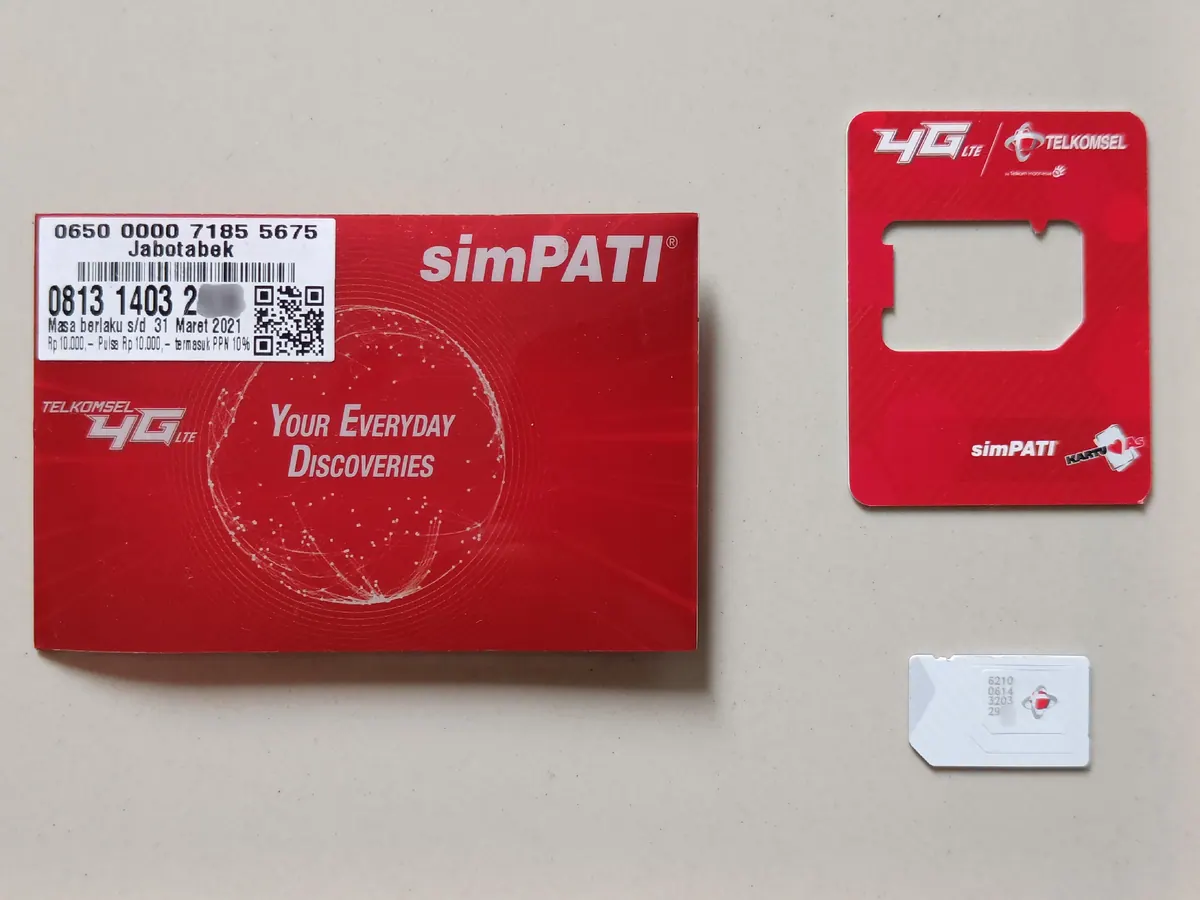

If your problem is arriving at Bali Airport and needing WhatsApp, maps and app transport, an eSIM wins. If your problem is uploading videos, tethering a laptop and spending a month in Indonesia, a local SIM may win. If your home carrier already gives you a decent roaming bundle, roaming may be the least annoying answer.
Bali eSIM or physical SIM card?
Choose an eSIM if your phone supports it, your phone is unlocked and you want data ready before you reach arrivals. This is the cleanest option for first-timers, late arrivals, villa check-ins and anyone planning to use Grab, Gojek or WhatsApp immediately.
Choose a physical SIM if you are staying longer, need a local Indonesian number, want local-network value, or plan to use lots of data. The trade-off is setup: passport, IMEI, registration, shop hours, airport pricing or pickup logistics.
| Need | Better default | Why |
|---|---|---|
| Airport arrival data | eSIM | Works before you start hunting for a SIM counter |
| Cheapest data for longer stay | Local SIM | Better value if setup is worth it |
| Local phone number | Local SIM | Travel eSIMs are often data-only |
| Laptop hotspot | Depends | Check hotspot and fair-use rules before buying |
| Multi-country trip | Regional eSIM | Useful for Singapore, Thailand, Vietnam or Malaysia add-ons |
| Bali plus Lombok/Java | Indonesia plan | Check network partner and coverage outside Bali |
If you choose by trip length instead
Do not buy by provider name first. Buy by trip length and data behavior.
| Trip length | Practical default | Current example checks | Watch out for |
|---|---|---|---|
| 1-3 days | Small fixed-data plan or fair home roaming | Airalo or Nomad 1GB plans can be enough if you mostly need arrival data | Activation timing can waste a short plan |
| 5-7 days | 5-10GB fixed-data travel eSIM | Airalo or Nomad fixed-data plans are the clean first checks | Video uploads and hotspot burn data fast |
| 10-14 days | 10GB+ fixed-data plan | Airalo 10GB/30-day or Nomad 10GB/30-day style plans fit the shape | Some plans expire before the trip ends |
| 30 days | Compare larger eSIMs with Telkomsel foreigner/local SIM value | Nomad larger bundles, Airalo 20GB/30-day and Telkomsel foreigner SIM are useful comparisons | Local SIM may beat travel eSIM pricing if setup is worth it |
| Heavy data / remote work | Large fixed-data, unlimited-style eSIM, plus real Wi-Fi | Nomad larger-data plans and Holafly unlimited-style options reduce top-up anxiety | Fair use, tethering and speed management matter more than the headline word “unlimited” |
For a one-week Bali trip, the boring answer is usually a small or medium travel eSIM before departure. For a month, compare Telkomsel foreigner/local SIM options and travel eSIMs after you know how much setup friction you are willing to tolerate.
More traveler-type notes
First-time visitor: Buy a travel eSIM before you leave. You need arrival data more than you need the largest plan.
Short trip: Use a travel eSIM unless your home roaming is genuinely good value. For 3-10 days, the convenience premium is usually fair.
Bali-only trip: Choose an Indonesia or Bali-compatible eSIM. Do not pay for a regional Asia plan unless you are also visiting another country.
Indonesia multi-island trip: Check the network behind the eSIM. Bali, Jakarta and Yogyakarta are not the same as remote beaches, mountain villages, boat routes or smaller islands.
Heavy data user: Compare fixed large-data plans, unlimited-style eSIMs and local SIMs. Unlimited rarely means “do whatever you want forever at full speed.” Let us be adults. Use Bali Travel Budget if data costs are part of a bigger trip-cost check.
Backup only: Buy a small plan and keep it for airport, maps, transport and emergencies. Use hotel Wi-Fi for updates, uploads and bored scrolling. Your data plan does not need to fund every quiet moment in a cafe.
Popular provider types to compare
This is not a lab-tested ranking. It is a shortlist of common options travelers compare for Bali and Indonesia.
| Provider or route | Useful for | Check carefully |
|---|---|---|
| Airalo Indonesia eSIM | Fixed-data travel eSIMs, short trips, simple setup | Current data tiers, network partner, top-up, support and activation timing |
| Holafly Indonesia eSIM | Travelers who want larger or unlimited-style data | Fair-use policy, hotspot rules, price and whether data-only is enough |
| Nomad Indonesia eSIM | Fixed-data and unlimited-style options, multi-day plans | Network, hotspot, add-ons, activation window and local number details |
| Telkomsel foreigner SIM / local SIM | Longer stays, local-network value, local calls | Passport, IMEI, pickup points, registration, current price and package validity |
| Home roaming | Zero shopping, zero extra setup | Daily fees, data caps, speed throttling and accidental roaming charges |
Current source notes: Airalo shows fixed-data Indonesia packages; Holafly sells unlimited-style Indonesia plans with plan-specific data-sharing notes; Nomad lists Telkomsel / Smartfren, hotspot support and add-ons; Telkomsel’s foreigner SIM page mentions passport, IMEI, Bali/Mandalika pickup and 30-day SIMPATI validity. Good value can exist locally. So can waiting, registration and shop logistics.
Setup, calls and troubleshooting
Airport SIM cards vs buying online before you fly
You can deal with SIM cards at or after arrival, including airport pickup or local operator routes. That can work, especially if you want a local SIM and do not mind admin after landing.
The airport option is not automatically bad. It is also not automatically the cheapest. You may pay for convenience, booth location, setup help and arrival timing. That is not a tragedy. It is a trade-off.
If your first Bali hour includes app pickup, villa directions or messaging a driver, buying online before you fly is cleaner. If your hotel transfer is already arranged and you are happy to sort connectivity later, a local SIM after arrival can be fine.
Do Bali eSIMs include calls, SMS or a local number?
Many travel eSIMs are data-only. That means WhatsApp, maps, ride apps, email and browsing work, but normal phone calls and SMS may not. Some providers or local SIM routes include calls or a local number, but you need to check the actual plan.
This matters if you need bank SMS codes, restaurant calls, local delivery calls, Indonesian app registration or old-school phone contact with a driver. Most tourist logistics can run on WhatsApp. Not all.
If you must receive SMS from your home bank, keep your home SIM active for SMS and turn off expensive data roaming. If you need an Indonesian number, compare local SIM options instead of assuming a travel eSIM includes one.
What if your Bali eSIM is not working?
Do not delete the eSIM profile immediately. That can make support harder.
Try this first:
- Confirm your phone is unlocked and eSIM-compatible.
- Check whether the eSIM is installed but not selected for mobile data.
- Turn data roaming on for the eSIM if the provider instructions require it.
- Restart the phone.
- Manually select the listed network partner if automatic selection fails.
- Check APN instructions in the provider app or email.
- Make sure the plan has actually started and has data left.
- Use airport, hotel or cafe Wi-Fi to contact support with screenshots and order number.
If activation fails before travel, fix it on Wi-Fi at home. Airport troubleshooting with luggage is one of those experiences that makes people suddenly interested in meditation.
Data use, arrival logic and common mistakes
How much data do you need?
For light use, 1-3GB can cover maps, messaging, ride apps and basic browsing if you use hotel Wi-Fi.
For normal use, 5-10GB is safer for a week or two with maps, searches, messaging, light social media and some photo uploads.
For heavy use, 20GB or more starts to make sense if you stream, upload video, work remotely, tether a laptop or move around without reliable Wi-Fi. For remote work, do not make one eSIM your whole continuity plan. Have real accommodation Wi-Fi and a backup.
The mistake is buying the tiniest plan because it feels efficient, then topping up in a panic after three days. Cheap is not always smart.
Airport arrival logic
Your Bali arrival data plan needs to solve boring tasks: message your driver or hotel, check Grab or Gojek, open maps, confirm the villa address, receive booking messages and avoid depending on airport Wi-Fi.
If you have a pre-booked hotel transfer, a printed booking and home roaming as backup, you can delay the SIM decision. If you plan to compare app rides, message a driver or navigate to a smaller villa, have data ready.
Do not install the eSIM for the first time while blocking a walkway at arrivals. Install it before departure. Screenshot the QR code or installation instructions. Keep your provider app logged in. Keep your normal SIM active for SMS only if you need bank codes, but turn off data roaming on the expensive line.
Common mistakes
- Buying an eSIM for a locked phone.
- Assuming every recent phone supports eSIM.
- Installing too late.
- Activating too early and wasting validity.
- Buying too little data.
- Buying unlimited data without reading fair-use terms.
- Forgetting hotspot rules.
- Assuming the eSIM includes a local phone number.
- Depending on 5G instead of checking actual coverage.
- Choosing the wrong country or regional plan.
- Deleting the eSIM profile before the trip ends.
- Expecting support to rescue you instantly without screenshots, order numbers or patience.
FAQ
Should I buy a Bali eSIM before arriving?
Yes, if you want maps, WhatsApp, ride apps and driver messages working right after landing.
Which eSIM provider is best for Bali?
For most short trips, start with a fixed-data Indonesia eSIM from a provider such as Airalo or Nomad. For heavy data, compare larger Nomad plans and Holafly unlimited-style plans. For 30 days or local-number needs, compare Telkomsel local or foreigner SIM options.
Does Airalo work in Bali?
Airalo sells Indonesia eSIM plans that travelers use for Bali, but the real answer depends on your phone compatibility, plan activation, network partner and exact location. Check the current Airalo Indonesia plan page before buying.
Is Telkomsel better than Airalo for Bali?
Sometimes. Telkomsel can be better value for longer stays, local calls or a local Indonesian number. Airalo travel eSIMs are easier for arrival and short trips because you can install before flying. This is convenience versus local setup, not a moral crisis.
Can I use Grab or Gojek with a Bali eSIM?
Yes, if the eSIM gives you mobile data and your app account already works. That is one of the main reasons to arrive with data ready: pickup points, driver messages, villa pins and payment checks are less annoying online.
Will an eSIM work everywhere in Bali?
No. Busy tourist areas are usually easier than remote beaches, mountain areas, thick-walled villas or rural roads.
Can I use hotspot with a Bali eSIM?
Maybe. Nomad currently says hotspot/tethering is supported. Holafly says data sharing depends on the destination plan. Confirm before buying.
What is the best eSIM for a 7-day Bali trip?
For most normal 7-day trips, a 5-10GB fixed-data travel eSIM is the safest default. Light users can use less; heavy social uploads or hotspot use need more.
Do Bali eSIMs include a phone number?
Many travel eSIMs are data-only. If you need normal calls, SMS or an Indonesian number, check the plan carefully or compare local SIM options.
What should I do if my Bali eSIM is not working?
Check eSIM selection, data roaming, APN settings, network selection, plan validity and phone compatibility. Do not delete the profile before contacting support unless the provider tells you to.
Official sources for eSIM and SIM details
Provider prices, data allowances, hotspot rules, fair-use policies, network partners and SIM registration rules can change. Check the current provider page before buying.

I'm the person behind Simply Indonesia. I lived in Yogyakarta and Bali for more than five years, which is long enough to know that Indonesia is amazing, messy, generous, occasionally confusing and very bad at fitting into generic travel-blog advice.
I'm also a manual-brew coffee nerd, dangerously loyal to sate klathak, and far too interested in the small practical details that decide whether a trip feels smooth or stupidly annoying.
I write these guides for travelers who want the useful version: how to get out of the airport, where to stay, what food actually tastes like, when paying extra is normal, and when something really deserves a hard no.
No fake hidden gems. No "paradise awaits" nonsense. No panic about every 50k IDR price difference.