Short answer
Yes, tourists can use QRIS in Indonesia if they have the right payment app set up before they need it. For many visitors, the practical path is GoPay or Grab with OVO: activate the app, add a small balance, open the scanner, scan the QRIS code, confirm the amount and pay.
That is different from the older tourist answer of “maybe, only if your home-country app supports QRIS Cross-Border.” QRIS Cross-Border still matters, but it is not the only path. If you can get GoPay or Grab/OVO working and funded, QRIS becomes much more useful for small payments.
The catch is boring but real: app access, phone number, wallet limits, verification, top-up method, internet connection and merchant handling. So use QRIS. Just do not leave the hotel with zero cash because one app worked at one cafe.
The practical tourist setup
QRIS works best for tourists when you stop thinking of it as a foreign-card feature and start thinking of it as a balance inside a local payment app.
| Setup | Can it work for QRIS? | Practical note |
|---|---|---|
| GoPay / Gojek with wallet balance | Yes, often | Good for QRIS-style local payments if your account, balance and phone setup are working. |
| Grab with OVO balance | Yes, often | Grab says OVO in Grab can pay merchants by scanning the merchant QR code. Test it before relying on it. |
| Supported QRIS Cross-Border home app | Yes, if supported | Depends on your country, bank or payment app. |
| Normal foreign Visa/Mastercard app | Not by itself | A card in your wallet is not automatically a QRIS wallet. |
| Apple Pay / Google Pay | Do not assume | Contactless card wallets and QRIS are different systems. |
| Cash | Always useful | Still the backup for app friction, weak signal and small vendors. |
If GoPay or Grab/OVO is already set up, topped up and tested on your phone, QRIS can feel easy. You scan, confirm the rupiah amount, pay, and show the merchant the success screen. That is the normal rhythm.
How GoPay works with QRIS
GoPay’s QRIS merchant help explains QRIS as Indonesia’s national QR standard and says one QR code can accept payments from different payment service providers. In normal traveler language: if the merchant shows a QRIS code, a compatible app such as GoPay can often scan and pay.
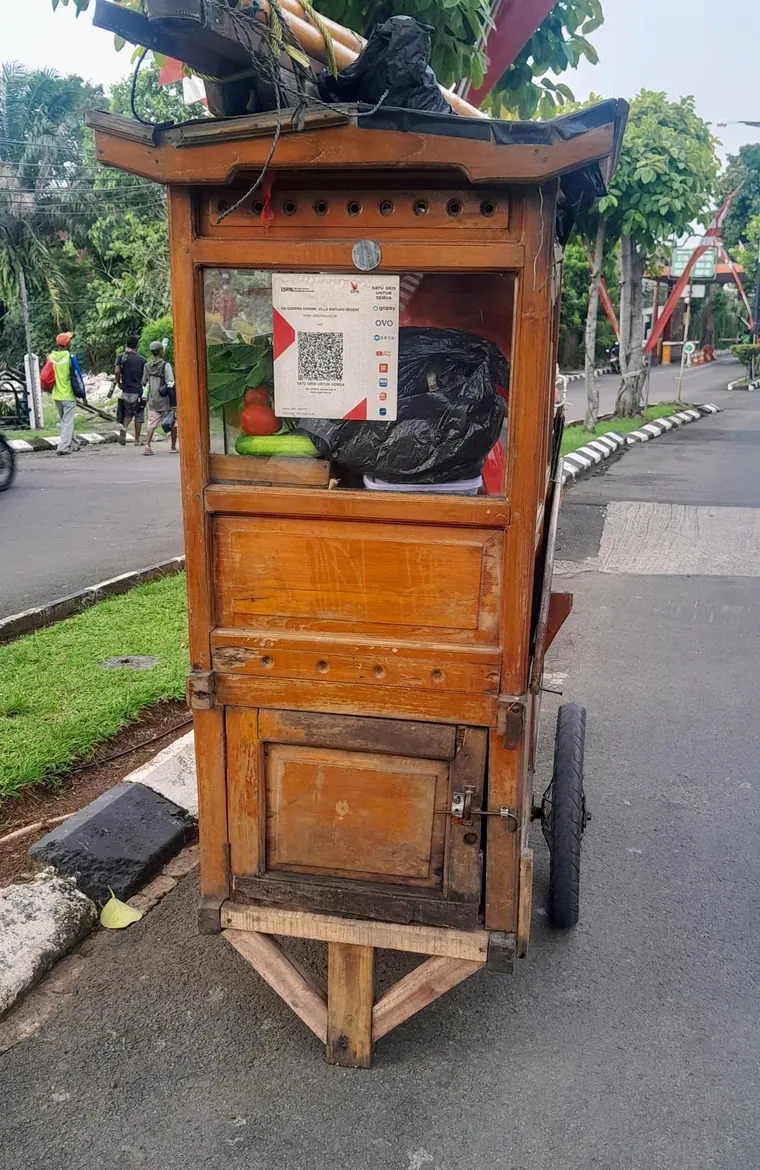

The tourist-friendly version:
- Install and activate GoPay or Gojek.
- Make sure the account can actually hold and use balance.
- Top up the wallet.
- At the merchant, choose scan/pay in the app.
- Scan the QRIS code.
- Confirm the amount and show the success screen if asked.
GoPay publishes top-up routes including bank transfers, virtual accounts, Indomaret and other app routes. Wise also says IDR transfers can be sent to mobile wallets including GoPay, OVO, DANA and ShopeePay, using the recipient mobile number starting with +62. That can be useful for tourists who can fund Wise by bank or card in their own country and send IDR into their Indonesian wallet.
Treat the registered phone number as part of the payment setup, not a small detail. Gojek’s GoPay top-up help says top-ups go to the destination phone number even if that number is inactive, so check the number before you send money to it.
Do not translate that into “every foreign card will top up GoPay directly.” The cleaner statement is: Wise can be a bridge to send IDR to a GoPay wallet where supported; GoPay itself also has local top-up routes.
How Grab and OVO fit in
In Indonesia, Grab’s wallet setup is tied to OVO. Grab’s Indonesia payment page says users can activate and top up OVO in the Grab app, and that OVO via Grab can pay merchants by scanning the merchant QR code.
That matters for tourists because many already use Grab for rides and food. If you can activate OVO inside Grab and add balance, you may not need a separate payment-app research project just to scan a local QR.
Grab lists several OVO top-up routes, including driver top-up, bank channels, minimarts, debit card and OVO merchants. Its bank top-up guide also ties the top-up to the mobile number registered in Grab. Whether your exact foreign card, phone number or verification setup works is the part to test early, not when someone is waiting for payment.
Topping up with Wise
Wise is useful because it can send IDR to Indonesian mobile wallets. Wise’s IDR help page says you can send to mobile wallets including GoPay, OVO, DANA and ShopeePay, and that transfers to mobile wallets need the recipient’s mobile phone number starting with +62.
That makes Wise a bridge, not a guarantee. The payment app still has to accept the money, the number has to be right, and the account limits still matter.
For a tourist, the clean version is:
- Create or open your GoPay/OVO wallet with an Indonesian phone number if required.
- In Wise, choose an IDR transfer to an e-wallet.
- Select GoPay or OVO if available on your route.
- Enter the wallet phone number.
- Send a small test amount first.
- Wait until the wallet balance appears before relying on it.
Wise routes, card funding, e-wallet availability, limits and verification can change. Wallets can also impose their own limits based on account status. Test with a small amount. This is not the place for one large heroic transfer because a comment thread said it worked.
When QRIS is useful
QRIS is most useful for small and medium local payments where cards are annoying or not accepted.
| Situation | QRIS usefulness | Backup |
|---|---|---|
| Cafes and casual restaurants | High if wallet works | Cash/card |
| Warungs, stalls and small shops | Often useful | Cash |
| Food courts and market vendors | Useful, but test first | Cash |
| Parking and small local fees | Useful when accepted | Small cash |
| Transport apps | Use the app’s own payment flow first | Cash/card/app balance |
| Remote areas and boat days | Do not rely on QRIS alone | Cash |
QRIS is not just a big-city gimmick anymore, but the more time-sensitive the payment, the more backup you want.
QRIS versus card versus cash
The best payment setup is boring:
| Payment method | Best use | Weak spot |
|---|---|---|
| QRIS via GoPay or Grab/OVO | Small payments, cafes, stalls, local merchants | Requires app setup, balance, phone access and signal |
| QRIS Cross-Border | Travelers with supported home-country apps | Country/app support is not universal |
| Card | Hotels, malls, bigger restaurants, online bookings | Small vendors may not accept cards |
| Cash | Markets, parking, rural routes, backup payments | Needs ATM planning and small notes |
Do not make this a moral debate. Use the tool that works. If QRIS works, great. If not, pay cash and move on with your life.
How to test QRIS without making it awkward
Test QRIS in a low-pressure place first. Buy a drink, snack or small item.
Check these things:
- Does your app scan the QRIS code?
- Can you enter or confirm the rupiah amount?
- Does the app show the merchant name correctly?
- Does the payment success screen appear?
- Does the merchant see success on their side?
- Does your wallet balance reduce correctly?
Do not test QRIS for the first time when a driver is waiting, a queue is forming or a boat ticket counter is closing. That is how a tiny payment issue becomes public theater.
If a place says QRIS only
Some small businesses are built around QRIS and may not care about card terminals. That is not automatically a scam. It may simply be how their payment workflow works.
If your QRIS setup works, scan and pay. If it does not, ask politely whether cash is possible. If not, choose another place. Do not make the merchant troubleshoot your Wise, GoPay, OVO, Apple Pay, foreign number and app verification situation. They are trying to sell food, coffee, parking or a ticket.
Country support still matters
QRIS Cross-Border is still useful if your home-country payment app supports Indonesian QRIS merchants. Bank Indonesia describes QRIS Cross-Border as letting international travelers pay at QRIS merchants in Indonesia through participating foreign payment applications.
But for many tourists, getting a local payment app set up and topped up is the more practical route. A traveler from a non-supported QRIS Cross-Border country may still use QRIS through GoPay or Grab/OVO if the app, phone number and balance are ready.
So the better answer is:
- QRIS Cross-Border works for some foreign apps.
- GoPay and Grab/OVO can work if the app is set up and topped up.
- Cash and cards remain the backup.
That is less neat than “yes” or “no”, but it is how travel payments actually behave.
What can still go wrong
QRIS is easy when everything is set up. It is annoying when one small part breaks.
Common failure points:
- Your wallet is not verified enough for the amount.
- You cannot receive OTP because the phone number is wrong, inactive or not the number linked to the app.
- Wise or another transfer route does not support your exact wallet/number/country that day.
- The merchant QR code is static and you enter the wrong amount.
- The payment succeeds on your phone but the merchant has not seen the notification yet.
- Signal is weak.
- The app logs you out at the worst possible moment, because apps enjoy drama.
The fix is simple: test early, keep cash, and do not depend on one wallet for the whole trip.
Why cash still matters
QRIS is excellent when it works. Cash is excellent when technology gets moody.
Keep small rupiah notes for:
- Small warungs and markets.
- Parking.
- Rural routes.
- Boat days.
- Tips and small local fees.
- Moments when the merchant’s phone, your phone or the internet gives up.
This is not anti-QRIS advice. QRIS is genuinely useful. The point is not to let one payment app become the boss of your trip.
What to verify before relying on QRIS
- Does your GoPay, Gojek, Grab or OVO account actually work in Indonesia?
- Can you hold and spend wallet balance?
- Can you top up through Wise, bank transfer, card, driver, minimart or another route?
- Does your wallet phone number start with
+62if required by your top-up route? - Can the registered phone number still receive messages or OTP checks if the app asks?
- What are your wallet limits?
- Does your home-country app support QRIS Cross-Border?
- Do you have enough cash if all of this fails?
Common mistakes
- Assuming QRIS means every foreign card wallet will work.
- Leaving the hotel with no cash because GoPay worked once.
- Sending a large Wise top-up before testing the wallet number.
- Trying QRIS for the first time during a rushed payment.
- Forgetting that wallet limits and verification can block larger payments.
- Treating a failed QRIS payment as a scam. It is usually just payment friction.
My take
For a normal tourist, the best setup if it works is GoPay or Grab/OVO with a small balance, plus cash and a card. That gives you QRIS for daily small payments without pretending Indonesia has become cashless everywhere.
If Wise can send IDR into your GoPay or OVO number, it can make the whole thing much easier: add balance, scan QRIS, pay from the app. If it does not work, do not fight it for an hour. Use an ATM, cash, card or another payment app.
FAQ
Can tourists use QRIS with GoPay?
Yes, if they can activate GoPay, add balance and pass any phone or verification checks the app requires. With GoPay balance, a tourist can often scan QRIS codes and pay local merchants. Test with a small payment before relying on it for the day.
Can tourists use QRIS with Grab?
Often yes through Grab’s Indonesia setup with OVO. Grab says OVO via the Grab app can pay merchants by scanning the merchant QR code. The practical requirement is that OVO is active, topped up and working on your phone.
Can I top up GoPay with Wise?
Wise says IDR transfers can be sent to mobile wallets including GoPay and OVO, using a mobile phone number starting with +62. Routes, limits, funding methods and wallet verification can change, so test with a small amount first.
Do I need an Indonesian phone number for QRIS?
Not always for QRIS Cross-Border. For local apps and top-ups, the phone number can matter a lot. Wise wallet transfers need a recipient mobile number starting with +62, and GoPay/OVO top-up routes can depend on the number registered in the app.
Can I scan QRIS with Apple Pay or Google Pay?
Do not assume that. QRIS is not the same as contactless card payment. Use GoPay, Grab/OVO, a supported QRIS Cross-Border app, cash or card depending on what works.
Is QRIS accepted everywhere?
It is very common, but not universal. Some merchants are QRIS-only, some are cash-only, some accept cards, and some have a QR code that does not cooperate when you need it. Carry cash.
Should I still carry cash if I use QRIS?
Yes. QRIS is useful, but cash is still the backup for weak signal, app limits, small vendors, rural routes, parking and awkward payment failures.
Related guides
Sources for changing details
Routes, fares, opening hours, app rules, weather, safety guidance, official portals and local operating details can change. Use these pages before relying on exact practical details.

I'm the person behind Simply Indonesia. I lived in Yogyakarta and Bali for more than five years, which is long enough to know that Indonesia is amazing, messy, generous, occasionally confusing and very bad at fitting into generic travel-blog advice.
I'm also a manual-brew coffee nerd, dangerously loyal to sate klathak, and far too interested in the small practical details that decide whether a trip feels smooth or stupidly annoying.
I write these guides for travelers who want the useful version: how to get out of the airport, where to stay, what food actually tastes like, when paying extra is normal, and when something really deserves a hard no.
No fake hidden gems. No "paradise awaits" nonsense. No panic about every 50k IDR price difference.