Short answer
Yes, you can get around Jakarta without renting a car. You probably still need occasional taxis or ride-hailing cars unless your whole trip sits neatly on the MRT.
The smart version is mixed-mode: MRT when it fits, KRL when the rail line fits, Transjakarta when the route is direct, walking only for short and sensible segments, and taxi or app car when Jakarta starts being Jakarta.
Where car-free Jakarta breaks
You can avoid renting a car. That does not mean every Jakarta trip should be public-transport-only.
| Break point | Better fix |
|---|---|
| Airport arrival with luggage | Airport train only if the final connection is clean; otherwise use a car. |
| Rainy evening | MRT where possible, taxi/app car for the ugly final leg. |
| Kota Tua plus South Jakarta plus PIK in one day | Split the day or use cars selectively. |
| Family travel with tired kids | Use rail for simple corridors, not as a moral rule. |
| Late-night food or nightlife | Plan the ride home before ordering another stop. |
The win is not never using a car. The win is not needing a rented car because you use the right mix of MRT, KRL, Transjakarta, taxis and walking.
Best strategy for most visitors
The best strategy is to choose a base that reduces transport pain. In Jakarta, hotel location is not a decoration. It is logistics.
Stay near the MRT if your plans are Central/South Jakarta, malls, Blok M, Senayan, Sudirman or Bundaran HI. Use where to stay in Jakarta before booking, because the hotel area decides whether no-car Jakarta feels clever or exhausting. Stay near your actual meetings or family if the trip is personal or business. Do not book a random cheap hotel and then blame Jakarta for being wide.
The official transport map can make Jakarta look more solved than it feels on the ground. MRT Jakarta is clear and visitor-friendly along its corridor. KAI Commuter is useful for commuter-rail-shaped trips. TransJakarta has a wide route network, but wide is not the same as simple. Taxis and ride-hailing fill the gaps. The winning move is not purity. The winning move is matching the mode to the trip.
Best transport by situation
| Situation | Best first choice | Backup |
|---|---|---|
| Central/South corridor, Blok M, Senayan, Bundaran HI | MRT | App car for last-mile gaps |
| Kota Tua, Bogor or commuter-rail-shaped trip | KRL | Taxi if the station access is awkward |
| Direct bus corridor | Transjakarta | App car if transfers get silly |
| Rain, luggage, late night or kids | Grab, Gojek car or Bluebird | Hotel taxi or mall taxi queue |
| Short local pocket | Walk | Stop walking when heat, crossings or rain win |
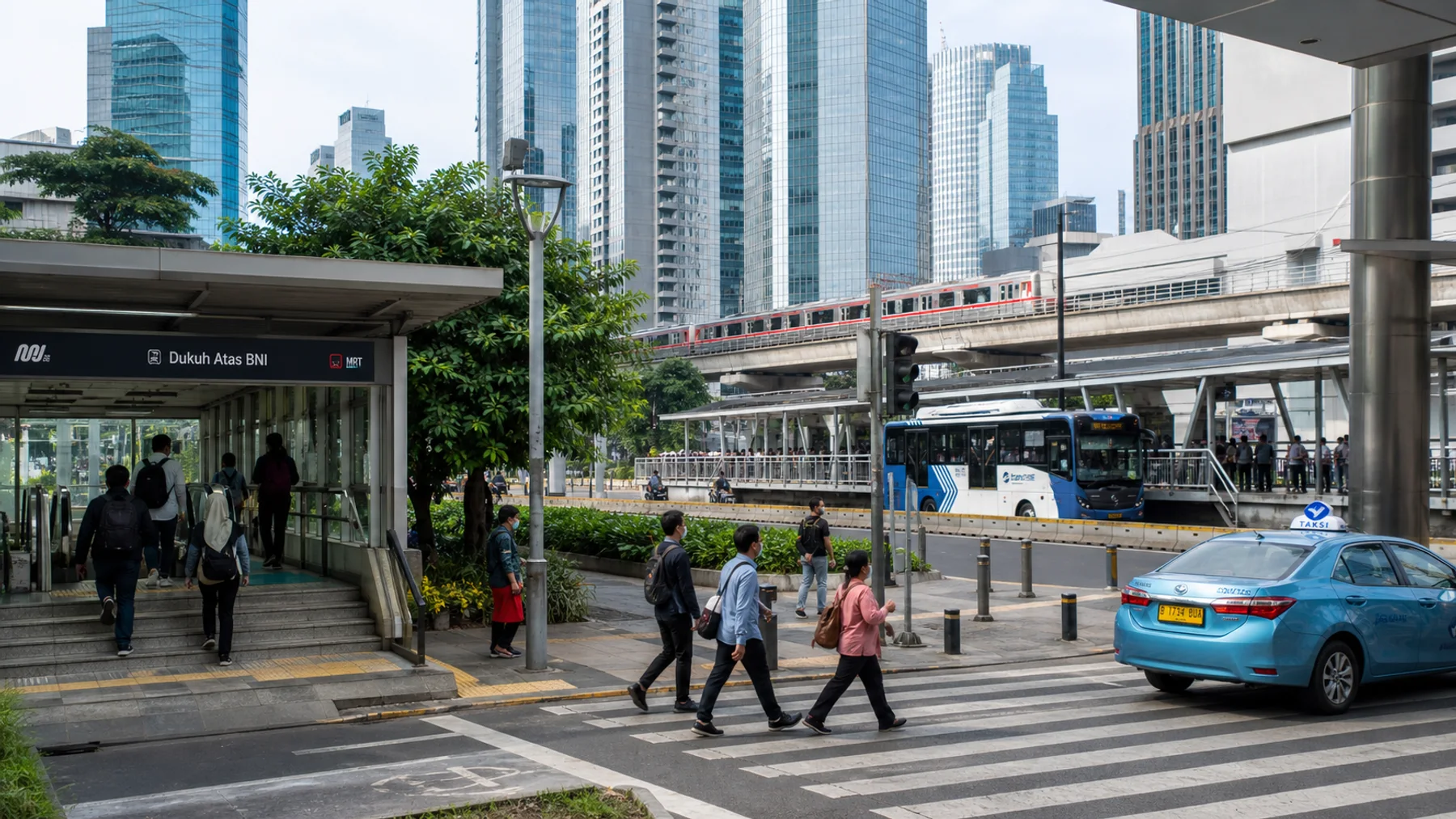
If you want a no-car Jakarta trip, choose the hotel before choosing the transport fantasy. Bundaran HI, Dukuh Atas and Sudirman work for MRT logic. Blok M works for food, MRT and South Jakarta. Menteng and Central Jakarta work for classic sights. A random cheap hotel breaks the whole plan.
Compare the options
| Mode | Best for | Not great for | Check before relying on it |
|---|---|---|---|
| MRT | Central/South corridor, malls, Blok M | Kota Tua, airport, far suburbs | Fare, hours, payment |
| KRL | Jakarta Kota, Bogor, rail transfers | Short tourist hops on MRT corridor | Route map, fare, schedule |
| Transjakarta | Direct bus corridors, budget rides | Heavy luggage, confusing transfers | Routes, cards, stops |
| Grab / Gojek | Flexible point-to-point trips | Surge, pickup confusion, traffic | App behavior, payment |
| Bluebird | Taxi backup, hotels, airports, malls | Always-cheapest expectations | Queue/app availability |
| Walking | Short local clusters | Heat, rain, bad sidewalks, long distances | Route safety and shade |
Use MRT when it fits
MRT is the cleanest rail option for many tourists. It works especially well for the Central/South corridor: Bundaran HI, Dukuh Atas, Senayan, Blok M and southward station logic.
If both ends are close to MRT stations, use it. If one end is far from a station, count the last-mile ride honestly.
This is also why hotel planning matters. A hotel near Bundaran HI, Dukuh Atas, Setiabudi, Senayan, Istora or Blok M can make a no-car trip feel almost civilized. A hotel that is “near MRT” only if you ignore heat, road crossings and luggage is not the same thing. Open the map, check the actual station entrance, and look at the route on foot.
MRT is strongest for mall days, South Jakarta evenings, business corridor movement and trips where timing matters more than door-to-door comfort. It is weakest for Kota Tua, Ancol, PIK, East Jakarta and the airport unless you are connecting to another mode. For airport-specific rail logic, use the Jakarta Airport Train Guide.
Use KRL for commuter-rail trips
KRL is useful when the commuter rail map matches the plan: Jakarta Kota for Kota Tua, Manggarai connections, Bogor day trips and certain cross-city rail moves.
It is not automatically easier than MRT. It is busier, more commuter-oriented and more dependent on route confidence. Use it when the rail line is obvious.
For visitors, KRL makes the most sense when the destination is clearly on the commuter rail network. Kota Tua via Jakarta Kota is the classic example. Manggarai can be powerful for connections, but it can also feel like a lot if you are new to Jakarta, carrying bags or trying to decode platforms in a hurry.
Do not use KRL just because it looks cheaper. Use it because it is the right shape for the trip. If the route needs a taxi at both ends, the savings may be mostly symbolic.
Use Transjakarta for direct bus routes
Transjakarta can be excellent value when the route is direct. It can also be annoying when stop names, transfers and detours stack up.
For tourists, focus on obvious corridors and verified routes. The route list is large; your patience is not.
The official TransJakarta route page is the right place to start, especially for airport SH routes, Kota Tua links, Blok M connections and north-side plans. Still, buses require more attention than MRT: direction, stop side, transfer point, service type and last-mile walking all matter. For the tourist version, use the Transjakarta guide.
Use TransJakarta when a route is direct or close to direct. Avoid it when the plan becomes three bus legs and a heroic sidewalk transfer. That is not budget travel. That is itinerary punishment.
Use Grab, Gojek and Bluebird as backup
Ride-hailing and taxis are not cheating. They are part of the Jakarta operating system.
Use them for:
- Airport arrivals.
- Late nights.
- Rain.
- Heavy luggage.
- Bad last-mile connections.
- Cross-town trips not served cleanly by rail.
- Moments when saving a small amount would cost too much patience.
The trick is to use cars selectively. A taxi for every trip can get expensive and slow. Public transport for every trip can get tiring and silly. A mixed-mode day might be MRT from Bundaran HI to Blok M, walking around Melawai, then a ride-hailing car back because it is raining and late. That is normal. You do not get extra travel points for suffering.
For app choice, pickup habits and taxi fallback, compare Grab vs Gojek in Jakarta before making every ride a fresh debate.
Stop being clever and take a car when it rains hard, when you have luggage, when the route needs awkward transfers, when you are with kids, or when the time saved is worth more than the fare difference.
Walking in Jakarta
Walk in short clusters, not across the city. Jakarta can be hot, wet, uneven and awkward for pedestrians. Some areas are fine for short walks around malls, MRT stations, hotels, Blok M or Kota Tua. Others are not worth forcing.
Good walking clusters include parts of Blok M around the MRT and Melawai, mall-to-mall movement around Bundaran HI when crossings are sensible, selected Menteng park and cafe routes, Cikini around TIM and nearby food, and Kota Tua once you are already inside the old-city cluster.
Bad walking plans usually start with “it is only two kilometers.” In Jakarta, two kilometers can mean heat, air quality, broken pavement, drainage, flyovers, crossings and a final stretch where the map technically works but your mood does not.
How to plan a no-car Jakarta day
Build each day around one of three shapes.
Use a corridor day when the MRT or rail line does the heavy lifting. Example: stay near Bundaran HI, ride MRT to Senayan or Blok M, eat, shop, then return by MRT or taxi. This is the lowest-friction tourist pattern.
Use a cluster day when the area itself is the point. Example: Kota Tua plus Glodok, Menteng plus Cikini, or PIK plus one nearby food stop. Get to the cluster, do the cluster, leave the cluster. Do not keep crossing the city because you saved too many pins.
Use a car-assisted day when the destinations are not rail-shaped. Example: Ancol, PIK, Kelapa Gading, TMII or airport-area logistics. You can still be “without a car” in the sense of not renting one. You are simply using taxis or ride-hailing when public transport would turn the day into an obstacle course.
Where to stay if you do not want a car
For most first-time visitors, the easiest no-car bases are Central Jakarta near Bundaran HI, Dukuh Atas, Thamrin or Menteng, and South Jakarta near Blok M or Senayan if the itinerary leans that way.
Choose Cikini if you want a more practical Central Jakarta base with KRL access, food and TIM nearby. Choose Thamrin-Sudirman if you want malls, MRT, business hotels and less thinking. Choose Blok M if food, nightlife and South Jakarta matter more than old-city sightseeing.
Avoid choosing a far-flung hotel because it is cheaper unless the location fits your actual plan. Jakarta is very good at taking the money you saved on the room and collecting it back through time, traffic and annoyance.
Sample no-car day plans
| Plan | Transport logic | Why it works |
|---|---|---|
| Central malls and MRT | MRT + short walks | Low friction if based near the line |
| Blok M food night | MRT to Blok M + walk/short ride | Strong station-area payoff |
| Kota Tua and Glodok | KRL or car + walking cluster | One focused old-city day |
| Rainy day | MRT or taxi between malls | AC, food, toilets, easy reset |
| Airport arrival | Train if light, car if tired | Match route to luggage and timing |
Common mistakes
- Choosing the cheapest hotel far from every actual plan.
- Overusing app bikes with luggage or in rain.
- Expecting MRT to cover Kota Tua or the airport.
- Expecting KRL to be as simple as MRT for first-timers.
- Treating buses as easy without checking the exact route.
- Walking too far because the map distance looks small.
FAQ
Can tourists visit Jakarta without renting a car?
Yes. Use MRT, KRL, Transjakarta, taxis and ride-hailing in combination. Do not rely on only one mode.
What is the easiest transport in Jakarta for tourists?
MRT is usually easiest when your route sits on the MRT corridor. For everything else, compare KRL, Transjakarta and car options.
Is Jakarta walkable?
Small clusters can be walkable. The city as a whole is not a casual walking city for tourists.
Should I use motorcycle taxis?
Only for short, light rides when weather, traffic and pickup feel sensible. Use a car for luggage, rain, late night or longer rides.
Related guides
Sources for changing details
Routes, stops, fares, payment rules, operating hours, transfer points and service updates can change. Use these pages before relying on exact transport details.

I'm the person behind Simply Indonesia. I lived in Yogyakarta and Bali for more than five years, which is long enough to know that Indonesia is amazing, messy, generous, occasionally confusing and very bad at fitting into generic travel-blog advice.
I'm also a manual-brew coffee nerd, dangerously loyal to sate klathak, and far too interested in the small practical details that decide whether a trip feels smooth or stupidly annoying.
I write these guides for travelers who want the useful version: how to get out of the airport, where to stay, what food actually tastes like, when paying extra is normal, and when something really deserves a hard no.
No fake hidden gems. No "paradise awaits" nonsense. No panic about every 50k IDR price difference.