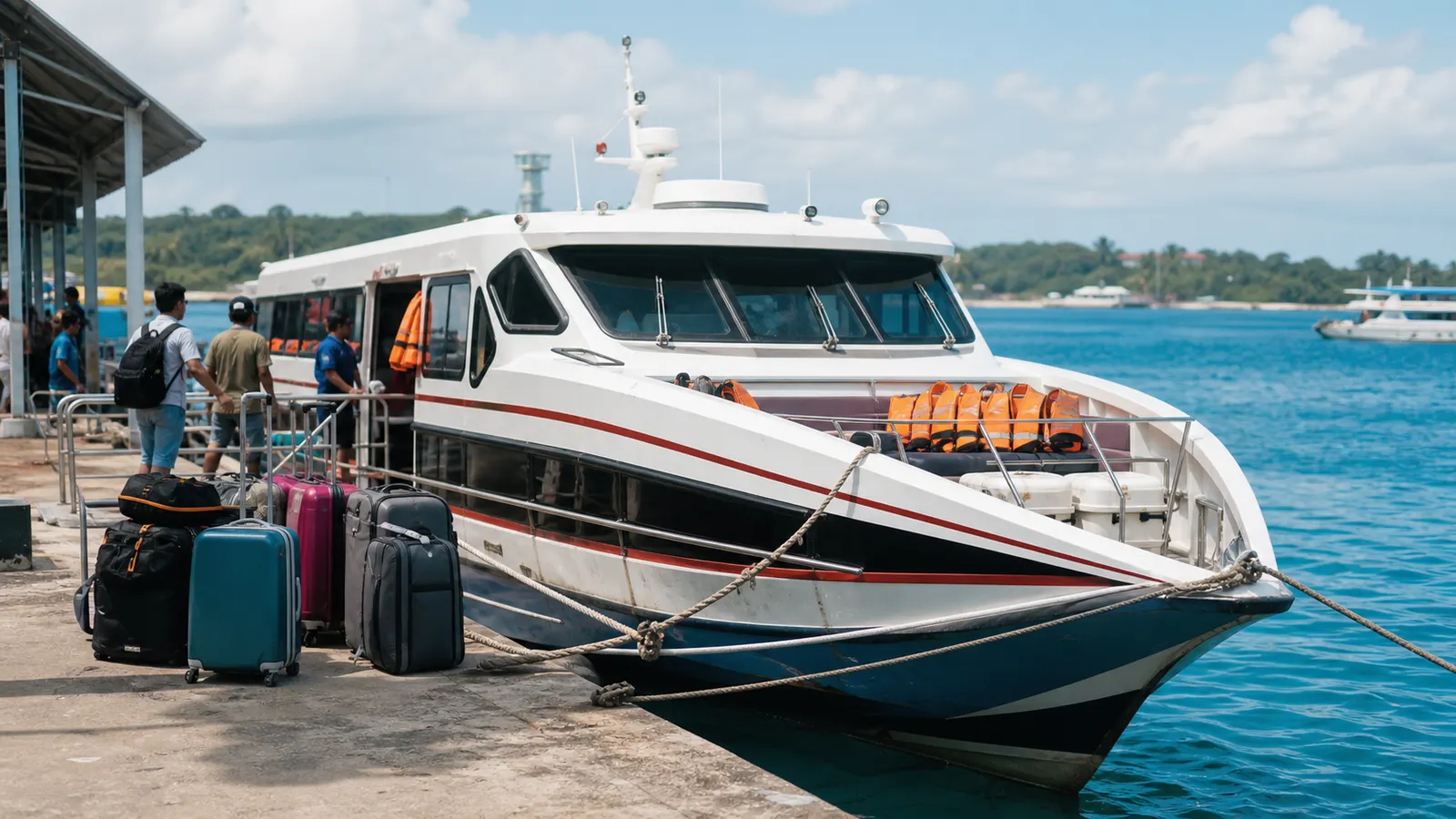
Short answer
Fast boats are the useful, imperfect middle layer of Indonesia island travel. They can make routes like Bali to Nusa Penida, Bali to the Gili Islands and Bali to Lombok practical. They can also turn a neat itinerary into a sweaty port argument if you ignore weather, luggage, check-in time and onward transport.
Use fast boats when the route makes sense and the sea day has room to fail. Do not book them as if they are trains with waves. The operator, port, season, luggage rule, sea state and arrival transfer all matter.
This page is about private tourist fast boats and similar speedboat-style routes. For public ferries, ASDP, Ferizy and PELNI, use the Indonesia Ferry Guide.
Before You Book a Boat
If you are comparing tickets, start here:
- Name the exact port. “Bali to Gili” is not enough. Which Bali port, which Gili arrival, which meeting point?
- Check the operator, not just the reseller. Resellers sell the ticket; the operator runs the boat.
- Check weather and sea warnings. BMKG maritime information and operator updates matter.
- Avoid tight same-day flights. A delayed boat can become a missed flight very quickly.
- Check luggage and boarding reality. Oversized bags, surfboards, strollers, wet boarding and beach landings need operator confirmation.
- Ask about children if relevant. Child-size life jackets are not something to assume on every boat.
- Look for visible safety basics. Life jackets, crew control, passenger count and weather judgment are not decorations.
- Have a Plan B. Slow ferry, flight, extra hotel night or route change beats denial.
Fast boats are convenient when the plan has slack. They are stressful when your whole itinerary depends on the sea behaving politely.
Where fast boats matter
Fast boats matter most on tourist island routes where public ferry options are slower, less direct or less convenient.
Common route families:
- Bali to Nusa Penida / Nusa Lembongan, often from Sanur and nearby harbour areas.
- Bali to the Gili Islands, often from Padang Bai, Serangan or other Bali-side ports depending on operator and season.
- Bali to Lombok, where fast boats compete with flights and slower ferry logic.
- Lombok to the Gilis, where short boat links connect airport, Senggigi, Bangsal and island stays.
- Labuan Bajo area boat trips, which are a different category when they become Komodo tours rather than simple transfers.
This page is not trying to replace every route page. It gives the fast-boat operating system. For route specifics, use Bali to Nusa Penida, Bali to Gili Islands and the relevant harbour guides.
Fast boat or ferry?
Fast boats and ferries solve different problems.
| Option | Better for | Watch out for |
|---|---|---|
| Fast boat | Tourist island transfers where speed and direct routing matter | Weather, seasickness, luggage, operator quality, tight flights |
| Public ferry / ASDP-style crossing | Vehicle crossings, budget travel and major public routes | Slower timing, port process, vehicle categories, queue logic |
| Flight | Bali-Lombok, longer island jumps, weather-sensitive plans | Airport transfers, baggage, price, limited route availability |
| Overnight buffer | Anyone with an international flight after island time | Extra hotel cost, but fewer expensive failures |
If the route is short and the weather is good, a fast boat can be a clean solution. If you are connecting to a long-haul flight, carrying too much luggage, traveling with anxious kids, or prone to seasickness, the “fast” option may not be the smartest option.
Weather and sea conditions
Sea conditions are not a detail. They are the route.
BMKG publishes maritime weather and high-wave warnings. Operators may also cancel, delay, reroute or change ports when conditions are bad. That is not always bad service. Sometimes it is the correct decision.
Check before travel:
- BMKG maritime and high-wave information;
- operator WhatsApp, website or social channel;
- harbour conditions on the day;
- hotel or driver updates if the route is local;
- your airline deadline if a flight is involved.
Do not make a same-day international flight depend on a weather-sensitive boat unless you can afford the failure. “The ticket says arrival at 11:00” is not a force field against waves.
Useful BMKG words:
| Indonesian | Meaning for travelers |
|---|---|
| Prakiraan cuaca maritim | Maritime weather forecast |
| Peringatan gelombang tinggi | High-wave warning |
| Gelombang tinggi | High waves |
| Perairan | Waters or sea area |
| Angin | Wind |
| Waspada | Be alert / warning |
You do not need to become a meteorologist. You do need to know whether the waters your boat will cross are being flagged before you treat the crossing like a fixed bus ride.
If you cannot read the BMKG map confidently, ask your hotel, driver or operator to help check the exact sea area, not just “Bali weather.” The relevant question is the water between the ports, not whether the cafe street is sunny.
When to add buffer
Add more buffer when:
- you have an international flight after the boat;
- the route is Bali to the Gilis or another longer open-water crossing;
- the trip is in rougher seasonal conditions;
- you are traveling with kids, older travelers or nervous travelers;
- you have large luggage;
- you cannot easily buy a replacement flight;
- the destination has limited alternative routes;
- you must be somewhere the same evening.
For major flights, the boring answer is often to return to Bali or the mainland the day before. Yes, that costs a hotel night. Missing an international flight usually costs more.
If a boat delay can turn into hotel, flight or missed-connection costs, check your insurance wording before the fragile link. That is not a harbour-counter job.
For day trips, buffer means not stacking dinner reservations, spa appointments or airport transfers too tightly after the return boat.
Seasickness and comfort
Fast boats can be bouncy. Some crossings are fine. Some are not. People who are normally fine in cars can still discover a new personality on a rough boat.
Useful habits:
- eat lightly before the crossing;
- avoid heavy alcohol the night before;
- sit where the crew tells you, not where your Instagram idea says;
- keep water accessible;
- keep a small bag with essentials at your feet;
- ask a clinician or pharmacist before using seasickness medication if you have health conditions, pregnancy, children or other medicine;
- choose a less fragile route if seasickness ruins travel days for you.
Do not wait until the boat is slamming through chop to discover you packed the seasickness tablets in the checked bag under six suitcases.
Luggage and boarding reality
Fast boats are not airport terminals. Boarding can involve narrow gangways, beach landings, wet steps, porters, quick loading and luggage piles.
Check:
- included luggage weight or size;
- surfboard or dive-gear rules;
- stroller handling;
- whether luggage is covered from spray;
- whether bags are carried by crew or porters;
- arrival beach or pier conditions;
- pickup and drop-off limits;
- whether your hotel area is actually included.
Keep passports, phones, medicine, wallet, glasses, chargers and valuables in a small carry bag. Do not hand over your only critical items inside a suitcase that disappears into the luggage pile.
Safety checks before booking
You do not need to inspect the engine room. You do need basic judgment.
Look for:
- clear operator name;
- current schedule and contact;
- weather and cancellation policy;
- visible life jackets or safety briefing;
- child-size life jackets if traveling with children;
- lifeboat or emergency-equipment logic on longer routes;
- reasonable passenger loading;
- professional boarding control;
- passenger manifest or check-in list;
- a real check-in point;
- reviews that mention safety and disruption handling, not just “friendly staff”;
- willingness to delay or cancel in bad weather.
Be careful with:
- unclear operator names;
- vague pickup promises;
- unusually cheap tickets with no explanation;
- old screenshots of schedules;
- no clear luggage policy;
- pushy sellers telling you weather never matters;
- boats that look overloaded or chaotic at boarding.
Do not board if the basics feel wrong
- The boat looks overloaded or boarding feels uncontrolled.
- You cannot see life jackets or the crew avoids safety questions.
- Children are traveling but no child-size life jackets are available.
- The operator pushes departure despite obvious rough weather or local warnings.
- You are being moved to a different boat, port or operator without a clear explanation.
Losing a ticket is annoying. Ignoring a bad safety signal can be worse.
If you travel with children
Ask before booking whether child-size life jackets are available, how boarding works, whether the boat has shade or toilet access, and whether the route is rough that day. Do not assume an adult life jacket is a child safety plan.
Questions before you pay
Ask these before the ticket turns into a sunk-cost problem:
| Question | Why it matters |
|---|---|
| Which operator runs the boat? | A reseller name is not the same as the boat company responsible for the crossing. |
| Which exact port and meeting point? | ”Sanur” or “Padang Bai” can still involve different counters, piers and pickup logistics. |
| What happens if weather cancels the boat? | You need to know refund, reschedule, reroute and hotel-night reality before the sea answers for you. |
| What luggage is included? | Big suitcases, surfboards, dive gear and strollers are not all handled the same way. |
| Are child-size life jackets available? | Official travel advice warns they are not always available on boats. Ask before you bring children. |
| Do they use a passenger manifest or controlled check-in list? | Counting passengers and controlling boarding is basic sea-day discipline, not paperwork theatre. |
| Is hotel pickup actually included? | ”Included transfer” often has zones, cutoffs and pickup-time friction. |
| Can I safely make my flight? | If the honest answer is “only if nothing goes wrong,” add a night or change the route. |
This is not overplanning. This is the cheap part of fixing the problem.
Route examples
Use these as planning logic, not as current schedules.
Bali to Nusa Penida
Usually the easiest fast-boat route for first-timers, but still not frictionless. Sanur-area departures, check-in windows, beach or harbour boarding and return timing matter. Do not book the last possible return if missing it wrecks the day.
Use Bali to Nusa Penida and Sanur Harbour Guide for route specifics.
Bali to the Gili Islands
Longer, more exposed and more buffer-sensitive. Padang Bai is a common Bali-side port, but operators and ports vary. The Gili arrival side matters too, especially if your hotel is on a different island.
Use Bali to Gili Islands and Padang Bai Harbour Guide for route specifics.
Bali to Lombok
Compare fast boat, flight and public ferry logic. A fast boat can make sense for certain coastal plans and Gili-linked routes. A flight can be better if you hate rough water or need reliability. The slow ferry is a different system.
Use the Indonesia Ferry Guide for public-ferry context, and compare fast boats against flights when mainland Lombok is the actual destination.
Fast-boat mistakes that actually get expensive
- Booking a same-day international flight after a weather-sensitive boat.
- Buying from a reseller without knowing the real operator and exact port.
- Putting passport, medicine, phone or wallet into the luggage pile.
- Ignoring unsafe boarding, overloaded boats or missing child-size life jackets.
FAQ
Are fast boats in Indonesia safe?
Many travelers use fast boats without issues, but quality, weather judgment, route exposure and operator standards matter. Use reputable operators, check sea conditions, look for visible safety basics and avoid boats or boarding scenes that feel chaotic or overloaded.
Should I book a fast boat before an international flight?
Avoid tight same-day boat-to-flight plans. If missing the flight would be expensive, return the day before or build a serious buffer. Weather, port delays, sea conditions and luggage handling can break a neat schedule.
Are fast boats worse in rainy season?
They can be more disruption-prone when weather and sea conditions are poor, but sea state varies by route and day. Check BMKG maritime information and operator updates near departure instead of relying on a generic season answer.
Which is better: fast boat or public ferry?
Fast boats are usually better for direct tourist island transfers. Public ferries can be better for vehicles, budget travel and major crossings. Flights may be better for reliability on some longer routes.
What should I carry on the boat?
Keep passport, wallet, phone, medicine, glasses, chargers, light jacket or dry layer, water and anything valuable in a small personal bag. Do not bury essentials in luggage that goes into the hold or luggage pile.
What if I get seasick?
Plan before boarding: eat lightly, avoid heavy alcohol the night before, keep water accessible and ask a clinician or pharmacist about medication if needed. If you know rough water ruins you, choose the route with the least sea drama or fly when practical.
Do fast boats include hotel pickup?
Sometimes, but do not assume it. Pickup zones, included areas, driver timing and drop-off points vary by operator and booking channel. Confirm the exact hotel area, not just the island or city.
Can fast boats be cancelled for weather?
Yes. Operators may cancel, delay, reroute or change ports when sea conditions are bad. That can be annoying, but cancellation can also be the correct safety decision. Keep your booking terms, operator messages and hotel/flight evidence if the disruption becomes an insurance question.
Are fast boats OK with children?
Often, but ask specific questions. Check child-size life jackets, boarding style, sea conditions, luggage help, shade, toilets and whether your child can handle a rough crossing. For nervous families, a slower route, flight or overnight buffer may be smarter than pretending everyone will enjoy being bounced around.
Is this official transport advice?
No. This is travel-planning guidance based on maritime, transport and travel-advice sources checked on 2026-05-29. Check BMKG, operator updates, harbour details and your booking terms before travel.
Where to go next
Use this page for fast-boat judgment. Use these for the routes and wider transport system:
- Indonesia Ferry Guide for ASDP, Ferizy, PELNI and public-ferry context.
- Bali to Nusa Penida for the common Bali-Penida route.
- Bali to Gili Islands for the higher-buffer Gili route.
- Sanur Harbour Guide for Sanur-side departure logic.
- Padang Bai Harbour Guide for Gili/Lombok-side planning from Bali.
Sources for changing details
Ticket terms, schedules, opening hours, entry rules and event logistics can change. Use these pages for the current version before you build a plan around exact times, prices or access rules.

I'm the person behind Simply Indonesia. I lived in Yogyakarta and Bali for more than five years, which is long enough to know that Indonesia is amazing, messy, generous, occasionally confusing and very bad at fitting into generic travel-blog advice.
I'm also a manual-brew coffee nerd, dangerously loyal to sate klathak, and far too interested in the small practical details that decide whether a trip feels smooth or stupidly annoying.
I write these guides for travelers who want the useful version: how to get out of the airport, where to stay, what food actually tastes like, when paying extra is normal, and when something really deserves a hard no.
No fake hidden gems. No "paradise awaits" nonsense. No panic about every 50k IDR price difference.